“All good books have one thing in common — they are truer than if they had really happened.”
— Ernest Hemingway
The bell above the door gave its usual tired rattle as I stepped into Blackwood Exchange, carrying the smell of rain in with me. The store was warm, dim, and packed tight with old paper and warped wood shelves that looked older than I was. Somewhere deeper in the maze of books, a jazz station hissed softly through static.
Peter looked up from behind the counter without surprise.
“Got another one for you, Dan.”
He reached beneath the counter and held up a hardcover wrapped in a cloudy plastic sleeve like it was something fragile enough to crack under direct sunlight.
“The 1968 edition,” he said. “Before they changed the cover art.”
I took the book carefully. Stand on Zanzibar. John Brunner.
“Didn’t you already sell me this one?” I asked.
Peter shook his head immediately.
“Nope. You bought the seventies paperback. Different publisher. Different formatting. This one still has the original text blocks before they cleaned up some of the language.”
I opened the cover and checked the publication page automatically.
Doubleday. 1968.
“Hmm.”
“Told you,” Peter said, leaning back in his chair with the satisfied expression of a man who treated publishing history like professional sports statistics. “People think editions don’t matter. Half the time they quietly rewrite things.”
I flipped through a few yellowed pages. The paper smelled like dust, attic wood, and something faintly sweet.
“You actually read these,” Peter continued. “Most people just buy old hardcovers to match their furniture now.”
“Books should look read.”
“That’s because you’re over forty.”
I laughed quietly, tucked the book under my arm, and headed for the register while rain tapped softly against the front windows.
That was the thing about Blackwood Exchange.
I almost never left empty-handed.
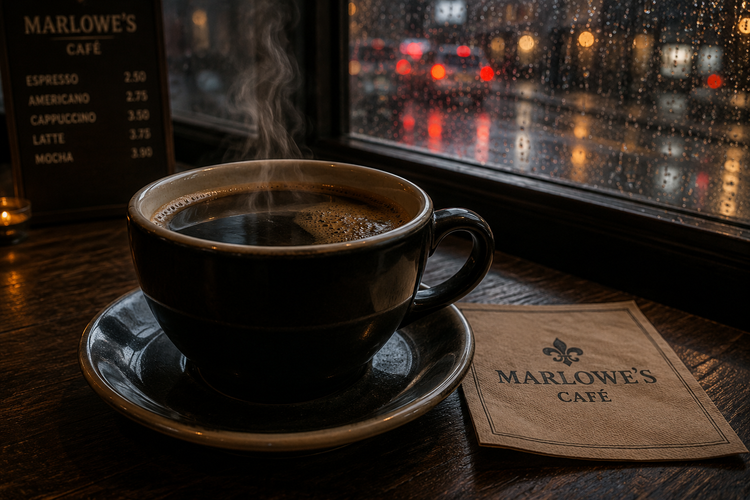
A minute later I stepped back out into the wet evening, crossed the narrow sidewalk, and pushed through the fogged glass door of Marlowe’s Café next door, already looking forward to coffee, rain, and a few uninterrupted chapters of somebody else’s future.
Nothing beats a good Americano. Only problem, I drink way too much of the stuff.
I sat at my usual spot and opened the book.
The waitress set the mug down in front of me with a practiced slide that stopped just short of the notebook already occupying half the table.
“Third one today?” she asked.
“Second.”
She glanced at the empty cup beside me.
“Right. Second.”
Marlowe’s always smelled like espresso grounds and wet coats when it rained. Half the people inside were hiding from weather. The other half were hiding from life. The windows had fogged over completely now, turning the street outside into blurred streaks of red brake lights and reflected neon.
I shrugged off my jacket and opened the hardcover again.
The dust jacket was in surprisingly good condition for its age. Minimal fraying along the spine. No library stamps. No water damage. Peter had probably spent half the afternoon pretending not to care while secretly restoring the plastic cover himself.
I turned to the copyright page again.
First edition.
Doubleday & Company.
Printed in the United States of America.
The usual publishing nonsense.
Still, something about it bothered me.
I couldn’t place why.
Maybe it was the font.
I frowned slightly and held the page closer to the table lamp.
The typeface looked wrong somehow. Not modern exactly. Cleaner. Too evenly spaced for an older hardcover. I rubbed my thumb lightly across the paper.
Offset print.
Not laser.
Definitely old.
Probably just restored plates or a later print run.
I flipped forward into the first pages.
The familiar fragmented structure started immediately. Headlines. Snippets. Context blurbs. Brunner always read like somebody dumping the future directly into a blender.
I took a drink from the Americano and smiled faintly.
God, I missed books like this.
Not modern nostalgia bait pretending to be science fiction. Not twelve-book military action franchises with identical covers and protagonists named things like Rex Steel. Books that assumed the reader could keep up or get left behind.
I turned another page.
Then stopped.
My eyes moved back up the paragraph slowly.
I read the sentence again.
And again.
The warmth of the coffee suddenly felt very far away.
No.
That wasn’t right.
I knew this book.
Not perfectly, maybe, but well enough.
I had read the paperback Peter mentioned at least twice over the years. Once in college. Again sometime during lockdown when everybody suddenly rediscovered dystopian fiction like it was a survival guide.
But this sentence—
I was certain it wasn’t supposed to say “online.”
I stared at the line.
The word sat there innocently between two commas.
Online.
Not networked.
Not linked.
Not connected.
Online.
A word nobody in 1968 science fiction used quite that way. Not casually. Not modern casual.
I checked the next paragraph.
Nothing unusual.
Back to the previous page.
Maybe I was misremembering.
Possible.
Happened more these days than I liked admitting.
I glanced toward the counter where an old wall-mounted television silently rolled through a twenty-four-hour news channel while captions crawled endlessly beneath talking heads. Market volatility. Water restrictions. Pacific trade disputes. Something about a drone collision over Chicago.
The world always sounded one bad week away from collapse now.
I looked back down at the page.
Online.
Maybe later editions had changed it and this was actually older wording.
No. That made no sense.
I pulled my phone from my pocket and searched for a scan of the original text.
Nothing useful came up immediately. Mostly resale listings and discussions arguing whether the book had “accurately predicted” the future.
One result mentioned:
restored modern formatting for readability
I hated phrases like that.
Publishers loved slipping things past readers under words like readability.
I flipped back to the copyright page again.
Something else caught my eye this time.
The ISBN.
I blinked.
Hardcovers from 1968 weren’t supposed to have thirteen-digit ISBNs.
I stared at the number for several seconds before the rational part of my brain finally kicked back in.
Sticker.
It was just a newer inventory sticker partially covering the original print.
I exhaled quietly and leaned back in the chair.
Jesus, Dan.
Too much caffeine.
Outside, thunder rolled somewhere over the city.
The lights inside Marlowe’s flickered once.
Nobody else seemed to notice.
I looked back down at the page one more time.
Online.
The word still felt wrong.
Not impossible.
Just wrong enough to itch.
NOTE FROM THE AUTHOR
This is still a very early draft of The Analog Collapse, and Chapter One is far from complete. I wanted to share a small piece of the project anyway to get honest feedback while the story is still evolving. If you have thoughts, theories, criticisms, ideas, or even small details that felt interesting or out of place, I’d genuinely like to hear them. One of the most enjoyable parts of writing science fiction is seeing what readers notice — especially when reality, memory, and history start to blur together a little. Feel free to leave a comment and tell me what you think so far. – Niel Oscar